PRACTICE WITH PURPOSE
PRACTICE
WITH
PURPOSE
The best players in the world don't just practice more - they practice smarter. Hitting balls feels productive. Improving your game is something else entirely.
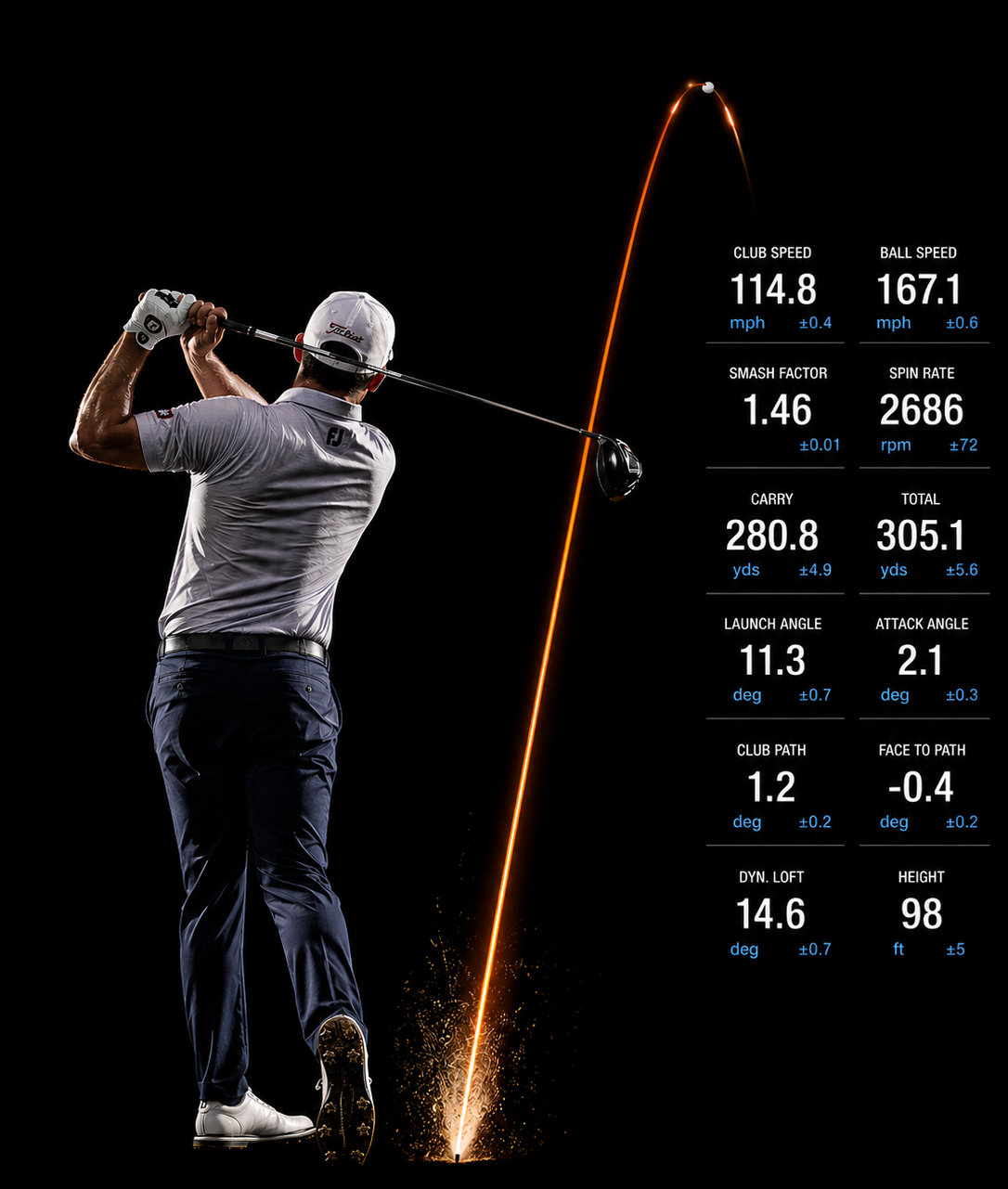
At Scratch, every shot you hit tells a story: launch angle, spin rate, club path, face angle, carry distance. Our simulators give you more data in one session than most golfers see in a lifetime - but data only helps if you know what to do with it.
This guide breaks down how to turn simulator time into real, measurable improvement, shot by shot, to make every session count.
1- DON’T WARM UP, WORK OUT.
There's a difference between a practice session and a workout. A workout has a goal, a structure, and a finish line.
Before you step into the bay, answer one question: what am I here to fix, or build?
You can keep it simple. "I need to get distance off the tee" is a goal. "I want to fix my slice" is a goal. Even "I want to understand my carry distances better" is a goal. Without one, you're just hitting balls. With one, every shot has a purpose.

2- LEARN TO READ THE NUMBERS
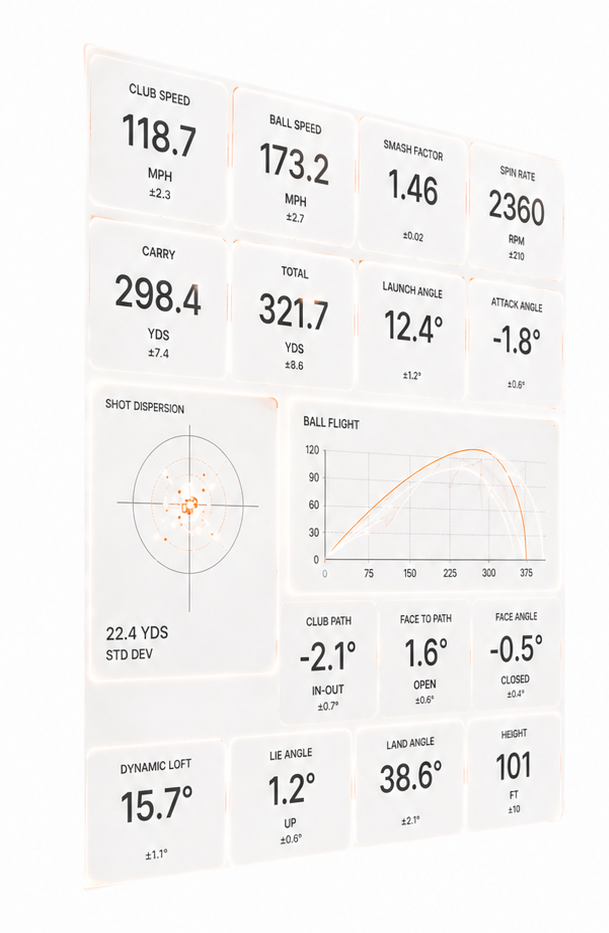
Trackman iO gives you a dashboard of datapoints. Here are the four numbers that matter most, and what they're actually telling you:
Club speed & ball speed These two together give you your smash factor (ball speed ÷ club speed). A smash factor of 1.48 or above with a driver means you're making solid, centred contact. If your ball speed is low relative to your club speed, you're leaking energy somewhere - usually off-centre strikes.
Launch angle For most golfers, driver launch angle is too low. The ideal window is 12–15° depending on your swing speed. Too low and you're leaving carry on the table. Too high and the ball balloons and loses penetration. Your launch angle is largely controlled by dynamic loft and angle of attack - two things the Trackman measures precisely. If your numbers are off, that's your starting point.
Spin rate High spin is the silent distance killer. A driver spinning above 3,000 rpm climbs fast and drops fast. Reducing spin while maintaining launch is where serious distance gains live. Trackman tells you your spin axis too, which reveals whether you're curving the ball, and why.
Club path & face angle The ball starts where the face points, and curves away from the path. If your face is 2° right and your path is 4° right, the ball starts right and draws slightly - that's a controlled shot shape. If your face is 4° left and your path is 2° right, you're looking at a big hook. It’s important to understand this relationship.
3- STRUCTURE YOUR SESSIONS LIKE A PRO
Block time, isolate problems, and measure progress. Here's a framework you can use in every session:
10 minutes - diagnostics Start with your stock shot, no pressure. Hit 8-10 balls with the club you want to work on and note your averages. Club speed, carry, spin rate, path and face. This is your baseline.
30 minutes - focused work Pick one variable to improve. If your path is 4° out-to-in and you want to neutralise it, work on that. Use the Trackman feedback after every shot to understand the cause. A shot that went left with a neutral path and closed face is a different problem to a shot that went left with an out-to-in path and square face.
15 minutes - pressure reps Finish every session under a little heat. Pick a target, a specific carry number, or a shot shape - and try to execute it 5 times in a row. This bridges the gap between technical practice and on-course performance.
5 minutes - log it Write down your key numbers. Carry average, smash factor, path and face averages, so you have data to compare against.
4- USE THE SIMULATOR FOR THINGS THE RANGE CAN’T GIVE YOU
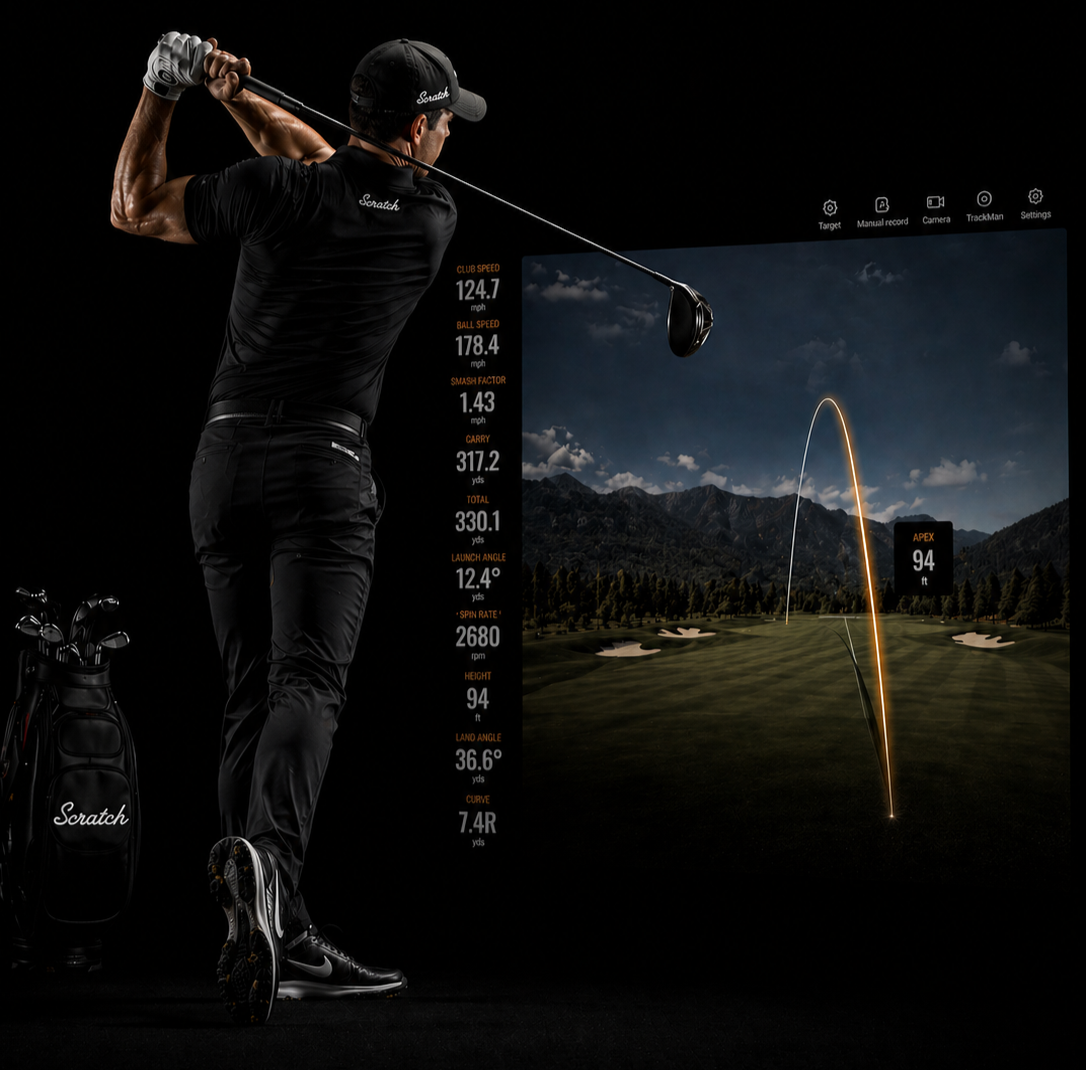
The range is great for volume. The simulator is great for precision. Here's what it can do that a driving range can’t:
Exact carry distances for every club in your bag. Not estimated. Measured. Build your yardage book from real numbers.
Shot shape on demand. Want to practice a controlled fade into a tight pin? Set the target, shape the shot, check the path and face data. Repeat.
Course management under pressure. Load a course, play a hole you always struggle with, and try different strategies. The sim lets you test decisions before you have to make them for real.
Weather and lie simulation. Playing into a headwind tightens dispersion and punishes spin. Use the conditions settings to practice shots you'll actually face.
READY TO PRACTICE WITH PURPOSE? CLICK THE BUTTON BELOW TO BOOK YOUR NEXT SESSION AT SCRATCH: